The CRE Finance Council’s CREFC Miami 2026 conference last week brought together commercial real estate finance experts in an atmosphere of optimism and confidence despite ongoing macroeconomic challenges. Optimism doesn’t mean turning a blind eye to the potential hurdles, though, and the Miami gathering coincided with the release of a white paper offering guidance on investment in this improving, but still unsettled, market.
Titled Lessons Shaping the Multifamily Market in 2026, the white paper from Louisville, KY-based CF Capital looks back over the past 12 months for guidance on how to proceed with the next 12. The regional real estate investment firm, which focuses on one asset class (multifamily) and four contiguous states (Kentucky, Tennessee, Indiana and Ohio) intends to illustrate “where decision-making pressure is most likely to concentrate in 2026.”
2025 ended with the Federal Reserve’s third consecutive 25-point reduction in the benchmark federal funds rate, setting the multifamily market up for what CF Capital terms “a clear inflection point.” The December rate cut elevated expectations for a reset across the capital stack, although the Fed has signaled that 2026 may bring only one additional cut.
Overview
As the multifamily industry reflects on 2025, the market enters 2026 at a clear inflection point.
After two years of elevated interest rates and muted transaction activity, the Federal Reserve’s December rate cut — its third of the year following moves in September and October — became a defining moment late in 2025, adding to the reset expectations across the capital stack. Together, the three 25-basis-point reductions brought the benchmark rate down to 3.50%–3.75% by year-end. Even so, Fed officials entered 2026 signaling caution, projecting only one additional cut this year as they wait for a clearer read on economic conditions.
For operators, lenders, and investors, the question coming out of 2025 is not whether the easing cycle has begun — it objectively has — but how quickly these cuts will translate into improved deal flow, pricing stability, and clearer underwriting.
Drawing from CF Capital’s transaction experience, market observations, and insights shared throughout 2025, this White Paper looks back at the lessons that defined the past year and outlines how they are shaping multifamily performance and investor behavior heading into 2026.
While national data provides important context, the emphasis here is on the pressures we observed on the ground throughout 2025: cap-rate shifts, operational headwinds, and the continued importance of conservative underwriting in a market where fundamentals remain sound but uneven.
These takeaways reflect not only where the market ended 2025, but where decision-making pressure is most likely to concentrate in 2026.
👉 Download the report now to explore how our investment principles and disciplined operations are creating opportunity despite today’s volatility.
As 2025 ends, the multifamily market finds itself in a period of recalibration rather than retrenchment. Headline narratives around interest rates, inflation and capital markets set the backdrop, but the defining forces of the year were far more practical: underwriting discipline, operational execution and market-specific fundamentals. For CF Capital, 2025 reinforced core investment principles while clarifying where opportunity continues to emerge.
Lessons From a More Selective Market
One of the clearest lessons of 2025 was that capital remains available, but only for strategies grounded in fundamentals. Lenders and institutional partners showed a strong preference for experienced sponsors, conservative leverage and business plans supported by in-place cash flow. In CF Capital’s Midwest and Southeast focus markets, assets with durable demand drivers continued to attract interest, even as credit conditions remained selective.
This environment underscored the importance of structure. Conservative assumptions, stress-tested underwriting and careful alignment between capital and business plans helped preserve flexibility throughout the year. In a market defined by uncertainty, optionality proved more valuable than aggressive leverage or speculative growth assumptions.
Wins Worth Noting
Despite a challenging backdrop, 2025 was a year of meaningful progress. Operational discipline translated into steady performance across the portfolio, particularly where NOI-focused initiatives took priority over headline rent growth. Leasing execution, tenant retention and expense management played a larger role in outcomes than broad market trends.
CF Capital also expanded its industry engagement and thought leadership, participating in many conferences and discussions focused on capital markets, underwriting and multifamily fundamentals. Equally important, communication with investors remained a priority. Clear reporting, timely market insights and transparency around strategy helped reinforce alignment throughout the year.
These wins reflect a broader emphasis on disciplined execution. In this cycle, value creation has been less about timing and more about doing the basics well, consistently and deliberately.
Market Signals That Shaped Strategy
Several trends stood out as 2025 unfolded. Capital flows varied sharply by asset quality and sponsor discipline, reinforcing the premium placed on well-structured deals. Operational fundamentals often diverged from national headlines, with local supply, demand and affordability dynamics driving performance market by market.
Debt strategy also emerged as a differentiator. As rates adjusted and volatility persisted, prioritizing fixed or hedged debt and maintaining flexibility within capital stacks helped stabilize returns. In many cases, thoughtful capital structuring proved just as important as asset selection.
Positioning for 2026
Looking ahead, CF Capital remains focused on clarity, discipline and execution. We believe 2026 will continue to reward investors and operators who align capital carefully with business plans, stay anchored in proven fundamentals and remain responsive to real-time performance data.
That means refining underwriting assumptions, stress-testing across a range of rate scenarios and maintaining a disciplined approach to acquisitions. It also means continuing to emphasize markets where population trends, employment bases and affordability support long-term demand for quality multifamily housing.
Final Thoughts
We appreciate the trust of our investors and partners and look forward to applying these lessons in the year ahead. If you’re evaluating opportunities for 2026 or want to discuss how these market dynamics may shape investment strategy, we welcome the conversation. As always, CF Capital remains focused on disciplined execution, thoughtful partnership and long-term value creation.

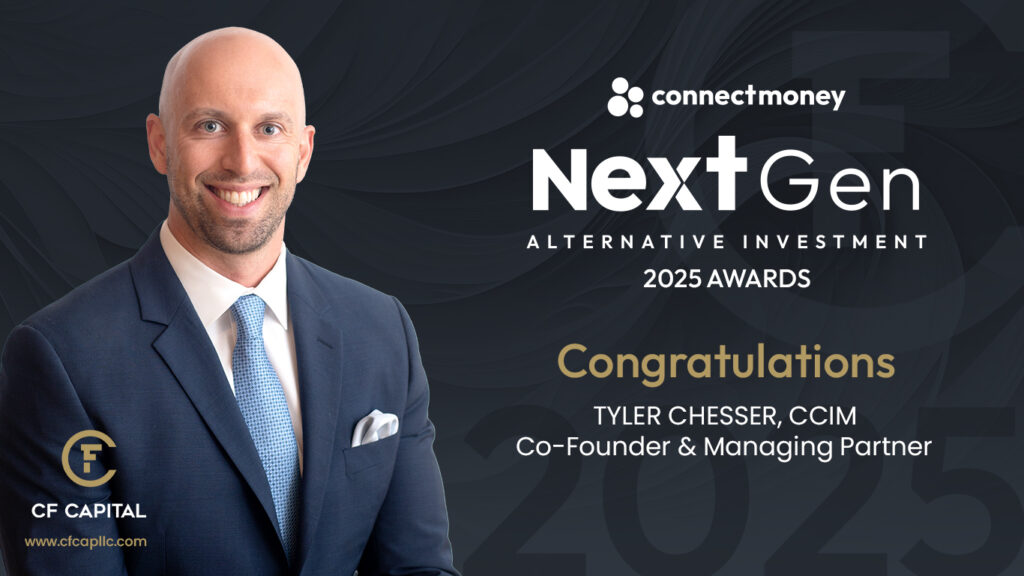
Congratulations to Tyler Chesser, CCIM, Co-Founder & Managing Partner of CF Capital, on being named a ConnectMoney NextGen Alternative Investment Award recipient.
Tyler’s leadership and forward-looking investment perspective continue to shape CF Capital’s approach to navigating complex markets and delivering long-term value. Well deserved.
As the year winds down, we’d like to take a breath and look ahead with curiosity. Not with strict forecasts, but with an open mind and a willingness to test some new ideas. That’s why we’re launching our first-ever 2026 Prediction Week. It’s a simple way to invite fresh thinking, compare notes across our network, and set the stage for a stronger start to the new year.
Before we share a few ideas, here is our favorite ‘stat’ of 2025:
Many of our investor conversations this year all circled back to one key question: “What will the next cycle look like?”
That question shows a clear shift. People are not waiting for certainty. They are actively searching for it and want to understand the next phase rather than react to it after it is underway.
CF Capital’s early view on 2026
These are not hard calls. They are signals we are watching as we build our plans for the coming year.
1. Capital efficiency becomes the new advantage.
Teams that manage capital with precision create meaningful separation from those who rely on older playbooks. Strong data, thoughtful structure, and quicker decision loops will matter even more as we move into 2026.
2. Real value outperforms noise.
The market continues to reward operators and investors who stay close to fundamentals. Clear cash flow stories and proven operational discipline rise above short-term swings and crowded narratives.
3. Partnerships drive momentum.
This year showed how much faster high-quality deals move when trusted partners are aligned. In 2026, we expect collaboration to remain a major accelerant, especially in complex or time sensitive opportunities.
Your turn
Prediction Week works best when more voices are in the mix.
-What trends are you watching as we head into 2026?
-Where do you see opportunity forming?
-What quote, stat, or insight shaped your thinking this year?
Share a thought with us on CF’s LinkedIn page (here). We will highlight a few responses and revisit them in early January.
Let’s close out the year with curiosity, focus, and a clear sense of direction.
As we look to 2026, CF Capital is positioning for a year grounded in discipline, clear execution, and investor alignment. The market continues to shift, and we believe success will come less from chasing growth and more from controlling outcomes.
Markets over momentum.
We’re doubling down on core geographies in the Midwest and Southeast—markets where affordability and population trends continue to support demand. Our focus remains on proven locations where we can add real value.
Selectivity over scale.
We’re not chasing deal volume. We’re focused on high-conviction acquisitions that offer clear, controllable upside. Conservative underwriting and strong fundamentals will drive our decisions—not pressure to deploy.
Smart capital structure.
Debt and equity alignment matter more than ever. We're staying disciplined on leverage, using fixed or hedged debt, and building in multiple exit paths. That structure reduces risk and protects returns.
Leasing drives results.
Our leasing strategy is faster, more targeted, and tenant focused. We’re refining lease-up timelines, improving renewals, and capturing rent premiums based on detailed unit-level data.
NOI-focused management.
We prioritize net operating income over speculative rent growth. This means smart renovations, tight expense control, and operational discipline. Every dollar spent must return value.
Transparent reporting.
We’ve always prioritized clear communication with our partners. In 2026, we’re further refining our reporting systems with enhanced monthly dashboards, performance metrics, and real-time renovation tracking.
Looking Ahead
We’re preparing for refinance windows with proactive planning, stress-tested scenarios, and capital stack flexibility. Every deal we evaluate includes multiple exit strategies, giving us room to adapt as conditions shift.
Above all, we believe that portfolios built on execution—not speculation—will lead in this next cycle. At CF Capital, that’s exactly what we’re building.
Final Word
2026 won’t reward hype. It will reward clarity, discipline, and follow-through. We’re ready. If you share our commitment to fundamentals and transparency, we look forward to growing with you in the year ahead.
If this type of diligent investing resonates with you, we invite you to explore investing alongside our team — sign up for our exclusive investor list here to learn about upcoming opportunities.
– The CF Capital Team
Following the Fed’s first rate cut since December 2024, the CRE sector is watching closely for clues about how far and fast monetary policy might change.
Chair Powell emphasized that although inflation remains elevated, weakening labor-market signals and a moderation of growth justified taking policy off its tightening course. The Fed’s 25-basis-point cut lowered the target range to 3.75%–4.00%, marking an inflection point in policy after an extended period of monetary tightening.
But what does that mean for investors and operators heading into 2026? Is this a true shift—or simply a recalibration in progress?
A Shift Toward Easing—With Caveats
This rate cut confirms that the Fed is transitioning from restrictive policy toward a more neutral stance. It’s a significant development for CRE capital markets, but not yet a signal for widespread easing.
Following the Fed’s announcement, 10-year Treasury yields eased by approximately 30 basis points in the days that followed—a sign that markets are increasingly pricing in a policy peak. That movement offered some relief after yields briefly breached 5% in October, their highest level since 2007. Still, credit spreads remain wide and risk premiums elevated, suggesting continued caution.
In other words, fundamentals still rule. Success in this phase of the cycle will hinge on asset quality, market selection, and operational execution—not cap rate compression.
Lenders Still Selective, But Conditions Improving
Across the capital stack, there’s been a modest uptick in engagement—especially among relationship-driven lenders focused on stabilized or lightly transitional assets. Credit standards, however, remain tight.
Floating-rate financing remains elevated, though the forward curve is beginning to price in further cuts later in 2025. Fixed-rate debt has regained appeal, with recent Treasury movement offering clearer pricing benchmarks.
Importantly, lender sentiment is becoming more segmented. Well-capitalized sponsors with disciplined business plans are finding capital, while more speculative projects are still finding limited traction.
In CF Capital’s target markets—including the Midwest and Southeast—we’re seeing lenders selectively reengage around multifamily assets backed by strong in-place cash flow and durable demand drivers.
What’s Next: A Cautious Path to Reengagement
We’re seeing early signs of renewed activity—particularly from groups that remained patient during the pricing reset of 2023–2024. But broad-based momentum remains limited.
Most investors appear to share a view: the Fed is done hiking, but rate relief will be slow, and market pricing still has room to evolve. In the meantime, underwriting discipline, operational upside, and local market insight remain the keys to execution.
At CF Capital, we’re particularly focused on submarkets where population and employment trends remain strong and where we can drive NOI growth through hands-on asset management—not speculative rent assumptions.
Final Thoughts
The Fed’s November rate cut marks a policy transition—away from tightening, but not yet into accommodative territory. For investors and operators, it brings welcome clarity, though not a green light.
In our view, deal volume will continue to build—selectively. Assets that can support current financing structures and provide stable yield will lead activity. Pricing discovery will continue into early 2025, but the directional shift from the Fed allows for more informed underwriting.
At CF Capital, we’ll continue tracking policy shifts, credit market signals, and on-the-ground fundamentals in our target markets. As always, we believe disciplined underwriting and ground-up execution remain the best compass in a shifting environment.
At CF Capital, acquiring and repositioning multifamily assets isn’t where the story ends—it’s where the value-creation journey begins. A successful exit is not simply the sale of an asset, but the culmination of a disciplined process, thoughtful execution, and a clear plan from Day One. Here’s how we approach what we call a high-conviction exit.
1. Setting the Exit Framework Early
Before acquisition, we think several moves ahead. A high-conviction exit begins with an exit framework built directly into underwriting.
We ask:
By defining these parameters upfront, we ensure every investment decision aligns with a clear endgame and measurable investor outcomes.
2. Creating the Value That Fuels the Exit
With the framework in place, execution takes center stage. Whether through unit renovations, amenity upgrades, operational efficiencies, or stronger community engagement, every initiative is designed to enhance net operating income and long-term desirability.
Our team tracks key performance indicators monthly—rent growth, occupancy, expense ratios—to stay nimble and proactive. This data-driven discipline ensures the property performs at its peak as market conditions evolve.
3. Reading the Market and Staying Ready
Timing a sale perfectly is impossible—but being ready isn’t. Because our underwriting includes multiple exit scenarios, we can pivot when opportunity strikes. If the market softens, we extend the hold and harvest cash flow. If conditions strengthen, we act decisively.
Flexibility is core to our value-creation and risk-management approach—allowing us to navigate economic cycles and protect investor returns.
4. Preparing the Asset and Story for Sale
When it’s time to exit, preparation drives performance. A well-positioned property—physically and financially—attracts stronger offers and closes faster.
We focus on:
Equally important is how the story is told. Each CF Capital asset represents not just financial strength, but community revitalization—an alignment that resonates with today’s buyers.
5. Executing with Precision and Transparency
A high-conviction exit demands flawless execution. From due-diligence readiness to investor communication, discipline guides every step.
We select buyers whose strategies align with the asset’s future, creating smoother negotiations and faster closings. At the same time, investors receive timely updates on timing, distribution structure, and outcomes—maintaining trust and alignment from start to finish.
6. Reflecting and Refining
Every exit is a chance to sharpen the process. Post-transaction, we analyze performance against projections, pinpoint what proved conservative or aggressive, and apply those insights to future acquisitions. This feedback loop drives continuous improvement across the portfolio.
Why It Matters
For CF Capital investors, a high-conviction exit means clarity, foresight, and follow-through. It’s not luck—it’s design. From acquisition to disposition, every decision supports one goal: to deliver consistent, risk-adjusted returns while creating lasting value for residents and communities.
Each exit is more than a milestone—it’s proof of process.
If you’d like to learn more about CF Capital’s value-creation and exit strategies, visit cfcapllc.com or reach out to our team. Let’s elevate communities—and returns—together.